
Description
The program aims to help student teachers or teacher candidates in dealing with professional situations and needs related to their work environment in an informed and well-founded manner. Training is thus designed to encourage autonomy without losing sight of elements of constant but flexible interaction, tailored to the specific needs of teachers in professional development.
The program is specifically aimed at primary- and secondary-level English teachers in public or private institutions, EFL teachers in adult education, and graduates with relevant qualifications intending to work as English teachers.
Learning Objectives
Competencies
- Manage professional situations and needs related to the work environment in an informed and well-founded manner, encouraging autonomy without losing sight of elements of constant but flexible interaction, tailored to the specific needs of teachers in professional development, facilitation training for primary- and secondary-level English teachers in public and private institutions, EFL teachers, and graduates.
- Provide education in new or unfamiliar environments of education within broad contexts related to teaching EFL so that students can apply the knowledge acquired, formulate judgments, make decisions, solve problems, and reflect on their own teaching and professional development.
- Provide students with the methodological tools for conducting specific educational research in language and linguistics applied to English teaching.
-
Outcomes
At the end of the program, students will be able to:
- Analyze, articulate, and evaluate learning and second language acquisition theories and the methodological trends in the teaching of foreign languages essential for effective teaching and successful learning.
- Analyze how individual factors (cognitive, affective, social, and cultural) affect foreign language learning, and design instructional strategies to address the learning needs of EFL students.
- Manage the EFL classroom so that group processes guarantee the learning of all students: creating a safe space in which all students participate and work collaboratively; using language that fosters the construction of knowledge; selecting activities of greater and lesser cognitive effort; selecting the type of grouping most appropriate for each activity; and paying attention to learning opportunities that may arise, among other aspects.
- Integrate language skill development in the EFL classroom to promote realistic and meaningful language use.
- Analyze, evaluate, select, adapt, and design adequate materials for the teaching of EFL.
- Make critical and reflective interpretations of English usage, applying cultural, linguistic, and pragmatic knowledge when planning the teaching and learning process of EFL.
- Analyze the implications of the role of English as a universal language of communication in EFL teaching.
- Design teaching proposals for the EFL classroom that integrate knowledge acquired about interlanguage concepts and interaction in the foreign language classroom.
- Plan and evaluate the short- and long-term English teaching-learning process, taking into account current linguistic pedagogical trends, the educational context, the methodological approach, lesson plans, students’ interests, needs, and learning styles, and technology advances.
- Integrate ICT in a meaningful, rather than arbitrary, way into the teaching activities for the EFL learning process, and critically analyze the digital materials created in the field.
- Integrate specific training in learning strategies within the program’s objectives and unit contents, aligning it to students’ needs while implementing the necessary learning-to-learn tools.
- Evaluate the usefulness of using a translation-based method for teaching English and design translation activities within the framework of communicative language teaching as a complementary tool to improve the EFL learning process.
- Analyze and evaluate the student’s own teaching and professional development through tools, such as self-observation, journaling, self-assessment, teaching portfolios, etc.; identify areas of learning that can be improved; and plan and implement a personal plan of improvement and lifelong learning.
- Access and correctly use academic literature related to language pedagogy and linguistics applied to foreign language teaching, especially literature related to the English language.
- Design and evaluate specific methodological procedures for research in the field of language pedagogy and linguistics applied to foreign language teaching, especially in research related to the English language.
Who Should Apply
The general profile of the course participants is as follows:
- Primary- and secondary-level Spanish and/or English (SFl and EFL) teachers, both in public and private institutions.
- Adult education Spanish and/or English (SFL and EFL) teachers.
- Graduates in related fields who intend to work as English and/or Spanish teachers (SFL and EFL).
Admission Requirements
To be admitted to the master’s program, applicants must meet the following requirements:
Academic requirements
Applicants must hold one of the following university degrees:
- Bachelor’s Degree in English Language and Literature or in English Philology.
- Bachelor’s Degree in Translation and Interpretation (English language).
- Undergraduate of any program comparable to the above, programs to be introduced in the future, or programs existing in the university systems of other countries.
- Undergraduate of any field who is able to provide documentary evidence of having received specific training in EFL teaching through the following means: formal elective coursework at the university level, university-specific degrees, training courses sponsored by institutions such as the British Council, or courses deemed equivalent by the competent body of the Universidad Internacional Iberoamericana.
Linguistic requirements
To be admitted into the program, applicants whose native language is not English and who have not obtained a university degree in which the language of instruction is English (English Language and Literature, Translation and Interpretation) must demonstrate that they have a sufficient level of academic English proficiency through one of the following methods:
- Achieve a minimum score of 550/667 on the Paper-Based TOEFL Test (PBT).
- Achieve a minimum of 230/300 on the Computer-Based TOEFL test (CBT).
- Achieve a minimum of 79/120 on the Internet-Based TOEFL test (iBT).
- Possess a minimum C1 English proficiency on the Common European Framework of Reference (CEFR).
- Submit a transcript showing successful completion of at least 30 credits per semester with an average grade of B or higher from an institution accredited by an agency recognized by the United States Secretary of Education and/or the Council for Higher Education Accreditation (CHEA), or a foreign institution with equivalent accreditation listed in the International Handbook of Universities.
In the absence of these certificates:
- Applicants are required to pass a master’s entrance exam, which is administered and evaluated by the Universidad Internacional Iberoamericana.
Duration
This master’s program features a three-part curriculum designed to apply student’s learning to real-life settings that are subject to continuous change. To graduate, students must earn the required number of credits within 24 months.
General education: 18 credits
Required: 48 credits
Electives: none
Structure
| MASTER IN TEACHING ENGLISH AS A FOREIGN LANGUAGE | ||||
|---|---|---|---|---|
| CODE | SUBJECT | PREREQUISITES | CREDITS | |
| GENERAL EDUCATION | ||||
| FP003 | Second Language Acquisition | N/A | 3 | |
| FP005 | Teaching Pronunciation | N/A | 3 | |
| FP004 | Individual Factors in the Learner's Development | N/A | 3 | |
| FP002 | Observation and Research in the Language Classroom | N/A | 3 | |
| FP001 | Approaches to Language in the Classroom Context | N/A | 3 | |
| FP037 | Content & Language Integrated Learning | N/A | 3 | |
| REQUIRED | ||||
| FP006 | Methodological Approaches | N/A | 3 | |
| FP008 | Developing Language Skills in the Classroom | N/A | 3 | |
| FP009 | Materials and Resources in EFL - Design, Creation, Adaptation, and Evaluation | N/A | 3 | |
| FP007 | Classroom Management - Techniques and Reflections on Practice | N/A | 3 | |
| FP010 | Computer Assisted Language Learning | N/A | 3 | |
| FP036 | Teaching English through Translation | N/A | 3 | |
| FP011 | Tasks and Projects | N/A | 3 | |
| FP014 | Learning Strategies | N/A | 3 | |
| FP013 | English in the Community | N/A | 3 | |
| FP012 | Assessment and Testing in the Classroom | N/A | 3 | |
| FP015 | Curriculum and Course Design - Principles and Practice | N/A | 3 | |
| FP034 | Practicum | N/A | 5 | |
| THESIS | ||||
| TFC | N/A | 10 | ||
| TOTAL | 66 | |||
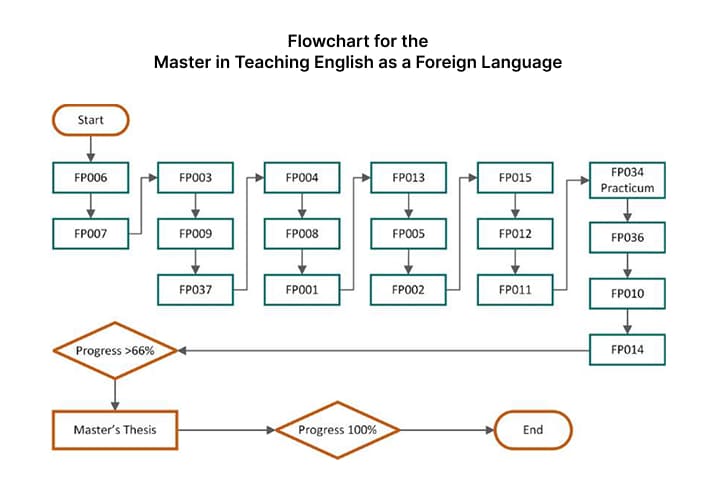
Diagram
Degree
Once the subjects and master’s thesis are approved and all academic, administrative, and financial requirements have been met, the following degree will be issued:
MASTER'S DEGREE IN TEACHING ENGLISH AS A FOREIGN LANGUAGE
Testimonials
- “Excellent program. Good organization, excellent associate professors, and a very practical platform.” End of Course Survey.
- “The academic program is excellent. Efforts should be made to expand its outreach to public schools across North Carolina, USA.” End of Course Survey.
- “The academic program was great, as expected. I was able to manage my time to complete every assignment and evaluation." End of Course Survey.
- “I am very grateful to the professors for their commitment and supportive attitude.” End of Course Survey.
- “Very good.” End of Course Survey.