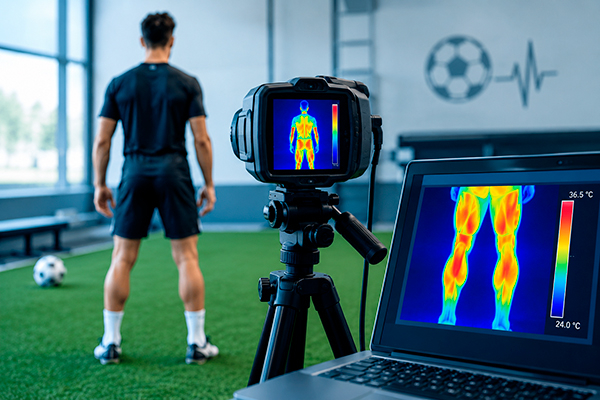
Dr. Álvaro Velarde Sotres, a researcher at the Universidad Internacional Iberoamericana (International Ibero-American University, UNIB), is participating in an international study on the use of infrared thermography to assess fatigue, injury risk factors, and recovery in soccer players.
The study was published in the journal Frontiers in Physiology, a prestigious international scientific journal ranked in the Q1 quartile in the physiology category. The research examines the use of infrared thermography, a technology that allows for remote observation of body surface temperature. The objective was to determine to what extent this tool can help identify signs of fatigue, detect differences between various muscle groups, and monitor players’ recovery.
Fatigue: A Challenge for Soccer Players
Professional soccer places increasingly high demands on athletes. Schedules can pack several matches into just a few days, leaving little time for the body to recover. This situation can lead to accumulated fatigue that affects performance and increases the risk of injury.
After a match, muscles need time to return to their normal state. Therefore, understanding how the body responds to exertion can help sports teams decide when to increase or decrease training intensity and which recovery strategies may be most appropriate for each player.
The post-match period is especially important. During the first 72 hours after a game, some effects of the exertion may persist, so having tools to monitor recovery can help prevent problems before they arise.
Technology to Monitor an Athlete’s Condition
Various technologies are used to monitor exertion and recovery, such as GPS devices and accelerometers, which track distances covered and changes in speed during a game. Other tools allow for analyzing movement during jumps or understanding how muscles respond.
However, there is interest in finding methods that are quick, simple, and can be used repeatedly without affecting the athlete’s performance. In this context, infrared thermography offers a non-invasive and rapid alternative. Using specialized cameras, this technology records skin temperature, and changes in skin temperature can provide information about the body’s response to exercise.
Three Potential Applications in Soccer
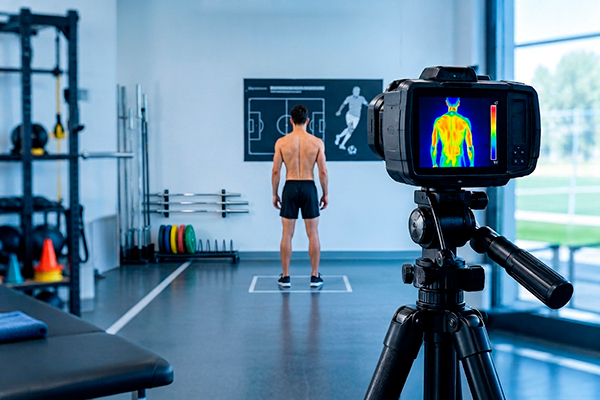
This study analyzed the available evidence in soccer players. The results show that infrared thermography can be useful for obtaining information about soccer players’ physical condition at different times.
The first is the assessment of fatigue, based on temperature changes that may occur after training sessions and matches. Observing these changes can help determine how the muscles have responded to exercise.
The second is the identification of potential signs of injury risk. Temperature differences between both sides of the body or between different muscle areas can help detect overuse or insufficient recovery.
The third application involves monitoring recovery. Measurements taken in the hours and days following exertion allow us to observe temperature trends and its gradual return to normal levels.
Toward a More Personalized Recovery
The studies analyzed used different measurement conditions, body regions, and equipment; therefore, the study concludes that more standardized protocols are necessary. Despite these differences, the results show that thermography can detect changes in skin temperature related to exercise and recovery.
Furthermore, it is suggested that thermal differences that remain outside normal ranges can serve as a signal to reassess training load and evaluate the athlete’s condition in greater detail.
This technique does not replace other tools or professional assessments, but rather can complement the information obtained through other methods.
If you’d like to learn more about this study, click here.
To read more research, check out the UNIB repository.
For professionals interested in delving deeper into this field, UNIB offers the Master’s in Physical Activity: Training and Sports Management. This program covers topics related to athlete assessment, monitoring training loads, and planning and implementing strategies aimed at improving performance and promoting injury prevention. Additionally, interested individuals can obtain a scholarship to pursue this master’s degree through the Ibero-American University Foundation (FUNIBER). Request more information via this link.