
Description
The purpose of the program is to train professionals with sufficient knowledge and resources to effectively and efficiently perform in the field of physical activity, focused on training and sports management.
The program is particularly aimed at qualified professionals and/or physical education graduates, teachers, professionals in health and sports sciences, and all those who wish to enrich their careers with topics related to physical activity, sports design and planning, and sports centers management.
Learning Objectives
Competencies
- Offer instruction in physical activity, sports design and planning, and sports center management for graduates in physical education, teachers, professionals in health and sports sciences, and all those who want to enrich their professional careers with issues related to sports management.
- Provide education in new or unfamiliar settings within broad contexts with sufficient knowledge and resources that students can use to make judgments, decisions, and solve problems.
- Provide scientific research tools that enable students to conduct research or produce creative work, demonstrating mastery of the material and ethical conduct.
Outcomes
At the end of the program, students will be able to:
- Seek to obtain and process information applied to scientific methodology and procedures to communicate and transform it into knowledge and apply it to the resolution of conflicts related to the field of sports performance and management.
- Analyze the main adaptations of the human body and apply the principles of biomechanics, physiology, psychology, and social sciences to different fields of sports and nutrition, identifying inappropriate practices involving a risk to health to prevent and correct them at different levels of action, age, and population groups.
- Identify the individual characteristics of athletes that influence and determine their sporting actions for the planning, programming, implementing, monitoring, quantification, and evaluation of the training process and competitions at different levels of action, competitiveness periods, age, and population groups.
- Analyze and resolve conflicts related to sports activities, and make informal decisions about solving individual professional tasks, in collaboration with others.
- Plan and implement strategies, develop and adequately evaluate professional tasks related to the field of sports training and management, and assume the ethical and legal commitments, contextual framework, and responsibilities required by the profession.
- Analyze, interpret, and apply ICT in the reflexive knowledge of the practical solution of professional and academic tasks proposed in relation to the sports field.
- Identify the influence of nutrition and diet as a tool for improving the performance of elite athletes.
- Describe and explain the management of infrastructures and technical areas of a sports organization and the processes for their optimization, identifying opportunities for information systems.
- Train managers and qualified staff in business and interpersonal skills to manage sports companies and institutions and understand the sports market.
- Acquire skills that enable students to continue training and learning in the field of sports management through contact with the teacher or independently.
- Acquire and consolidate initiative and entrepreneurial spirit to launch sports management projects.
- Analyze and identify different leadership styles, promoting the development of skills and attitudes to lead sports projects of collective professional development and transfer the progress experienced in the program to society.
Who Should Apply
The proposed educational methodology, combined with the clarity, amplitude, and didactic nature of the content design, allows the Master in Physical Activity: Sports Training and Management to be aimed at professionals or graduates in physical education, teachers, doctors, or health sciences graduates, as well as individuals who hold a degree in business administration, with experience in the sports sector.
Duration
The program must be completed within 24 months. The following is the credit structure of the MASTER IN PHYSICAL ACTIVITY: SPORTS TRAINING AND MANAGEMENT:
General Education: 24 credits
Required: 13 credits
Electives: 29 credits
Structure
| MASTER IN PHYSICAL ACTIVITY: SPORTS TRAINING AND MANAGEMENT | |||||
|---|---|---|---|---|---|
| CODE | SUBJECT | PREREQUISITES | CREDITS | ||
| GENERAL EDUCATION | |||||
| SN039 | Structure and Function of the Human Body | N/A | 3 | ||
| SN155 | Contextualization of Physical Activity and Exercise in the Health Framework | N/A | 3 | ||
| SN156 | Psychosocial Aspects of Physical Activity for Health | N/A | 4 | ||
| SN157 | Control and Prescription of Physical Activity | N/A | 3 | ||
| SN158 | Physical Activity for Health with Diverse Diseases | N/A | 4 | ||
| SN159 | Physical Activity in Children and Adolescents | N/A | 3 | ||
| SN160 | Physical Activity in Seniors | N/A | 4 | ||
| ELECTIVES | OPTATIVE MODULE: SPORTS TRAINING | ||||
| SN198 | Basics Aspects of Nutrition | N/A | 0 | ||
| SN048 | Training Theory and Practice | N/A | 4 | ||
| SN049 | Sports Planning | N/A | 4 | ||
| SN050 | Sports Psychology | N/A | 3 | ||
| SN042 | Kinanthropometry | N/A | 3 | ||
| SN043 | Ergogenic Aids | N/A | 3 | ||
| SN047 | Eating Disorders in Sports | N/A | 3 | ||
| SN217 | Nutrition and Sports | SN198 | 3 | ||
| DP004 | Management Techniques for Sports Team | N/A | 2 | ||
| SN228 | Study and Case Resolution for Sports Training | N/A | 4 | ||
| OPTATIVE MODULE: LEADERSHIP AND SKILLS FOR SPORTS CENTER MANAGEMENT | |||||
| DP001 | Administration and Management of Sport Entities | N/A | 3 | ||
| DP002 | Strategic Management and Planning of Sport Organizations | N/A | 3 | ||
| DP003 | Sport Marketing. Applications. | N/A | 3 | ||
| DD1021 | Strategic Management of Human Resources | N/A | 2 | ||
| DP004 | Management Techniques for Sports Teams | N/A | 2 | ||
| DP006 | Techniques for Management and Leadership in Sports | N/A | 2 | ||
| DP007 | Information Society and Sports | N/A | 3 | ||
| SN048 | Training Theory and Practice | N/A | 4 | ||
| SN042 | Kinanthropometry | N/A | 3 | ||
| SN229 | Case Study and Resolution for Management Skills | N/A | 4 | ||
| REQUIRED | THESIS | ||||
| FP092 | Methodology of Scientific Research | N/A | 3 | ||
| Master’s Thesis/Practicum | N/A | 10 | |||
| TOTAL | 66 | ||||
Diagram
Optitave Modules
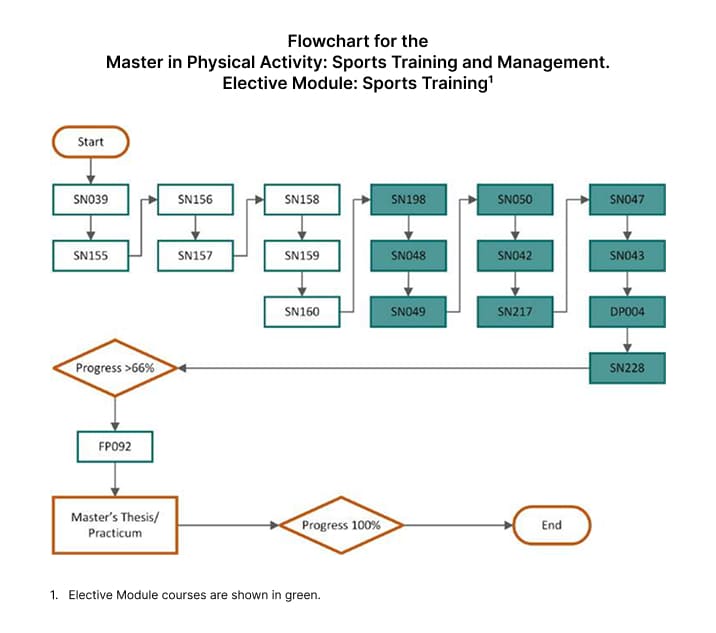
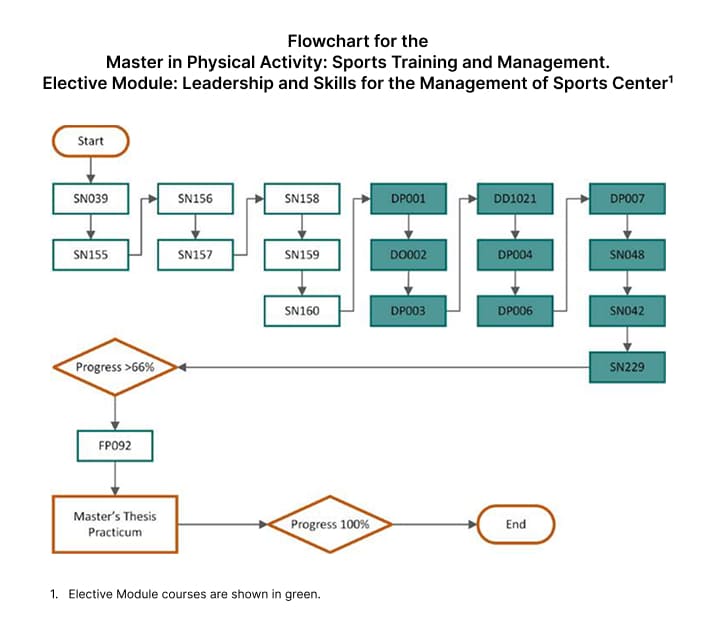
Optative Modules
Optative module credit structure:
| OPTATIVE MODULE: SPORTS TRAINING | ||||
|---|---|---|---|---|
| SN198 | Nutrition Basics | N/A | 0 | 0 |
| SN048 | Training Theory and Practice | N/A | 4 | 60 |
| SN049 | Sports Planning | N/A | 4 | 60 |
| SN050 | Sports Psychology | N/A | 3 | 45 |
| SN042 | Kinanthropometry | N/A | 3 | 45 |
| SN043 | Ergogenic Aids | N/A | 3 | 45 |
| SN047 | Eating disorders in sports | N/A | 3 | 45 |
| SN217 | Nutrition and Sports | SN198 | 3 | 45 |
| DP004 | Management Techniques for Sports Teams | N/A | 2 | 30 |
| SN228 | Case Study and Resolution for Sports Training | N/A | 4 | 60 |
Optative module credit structure:
| OPTATIVE MODULE: LEADERSHIP AND SKILLS FOR SPORTS CENTER MANAGEMENT | ||||
|---|---|---|---|---|
| DP001 | Administration and Management of Sport Entities | N/A | 3 | 45 |
| DP002 | Strategic Management and Planning of Sport Organizations | N/A | 3 | 45 |
| DP003 | Sport marketing. Applications. | N/A | 3 | 45 |
| DD1021 | Strategic Management of Human Resources | N/A | 2 | 30 |
| DP004 | Management Techniques for Sports Teams | N/A | 2 | 30 |
| DP006 | Techniques for Management and Leadership in Sports | N/A | 2 | 30 |
| DP007 | Information Society and Sports | N/A | 3 | 45 |
| SN048 | Training Theory and Practice | N/A | 4 | 60 |
| SN042 | Kinanthropometry | N/A | 3 | 45 |
| SN229 | Case Study and Resolution for Management Skills | N/A | 4 | 60 |
Degree
Once the subjects and master’s thesis are approved and all academic, administrative, and financial requirements have been met, the following degree will be issued:
MASTER’S DEGREE IN PHYSICAL ACTIVITY: SPORTS TRAINING AND MANAGEMENT
Testimonials
- “It met my expectations; I am very satisfied and recommend it.”. End-of-course survey.
- “Excellent organization, up-to-date study materials, well-organized, well-written, with accurate references. I am very satisfied. I hope to continue training through this methodology.”End-of-course survey.