
Description
The objective of the program is to train professionals in the field and practice of strategic management, providing an executive point of view that allows them to assume their current and/or desired managerial positions or enhance their careers in the field of organizational consulting. The variety of optional modules that structure the program allows it to cover fields such as marketing, auditing, family businesses, tourism consultancy, integrated environmental management, quality and prevention of occupational risks, human resources and knowledge management, conflict resolution and mediation, as well as healthcare organizations.
The program is specifically aimed at professionals from the fields of engineering, social sciences, administration sciences, and management and economic sciences, among others. The Master in Strategic Management is an ideal complement for these professionals, enriching their knowledge in company and business strategy, updating their knowledge, and acquiring new skills to be aligned with the latest standards in strategic management.
- Understand the strategic process of organizational management.
- Assume responsibilities within the strategic management process.
- Create proposals that integrate globalized and local processes when managing a business.
- Provide training in strategic management in one of the program’s areas of study.
Learning Objectives
Competencies
- Provide education to train professionals—especially those from engineering, social sciences, administrative science, and management and economic sciences—in the field and in the practice of strategic management, providing an executive mindset necessary to excel in their current or desired roles or to launch a career in organizational consulting.
- Provide education in new or unfamiliar environments for students to apply the knowledge acquired, formulate judgments, make decisions, and solve problems while understanding the strategic process of organizational management, assuming a role in strategic management, and making proposals that integrate general and local business management processes.
- Provide scientific research tools that enable students to conduct research or produce creative work ethically, demonstrating mastery of the material.
Outcomes
At the end of the program, students will be able to:
- Design a strategic process based on organizational diagnosis and assessment for the development of objectives and selection of strategies.
- Analyze and explain the organizational environment to improve internal processes, including standards, regulations, certifications, and accreditations.
- Integrate administrative processes and information technologies (IT) for decision-making and conflict resolution.
- Create a business marketing mix and propose a market research design.
- Analyze and apply conflict-resolution techniques and human resources knowledge for effective management of the work environment and human resources development.
- Design strategies for continuous improvement in the operations that influence the competitiveness and feasibility of the company.
- Identify roles, approaches, and practices to manage different business sizes and purposes, applying management accounting as a method for making financial decisions that help maximize business economics.
- Manage administrative and leadership skills, maintaining honest and transparent management principles in the achievement of objectives.
Who Should Apply
The proposed training methodology—combined with the clarity, breadth, and didactic nature of the context design—allows this master’s degree to be aimed at professionals who have ventured into or wish to enter the field of administration, management, or business leadership, without prior training in this field or who lack a comprehensive vision of strategic management. This master’s degree is aimed at professionals from the fields of engineering, social sciences, administration and management sciences, economics, and bachelor’s degrees, among others.
Duration
The program must be completed within 24 months. The following is the credit structure of the Master in Management with a Specialty in Management
General education: minimum 9 credits
Required: 13 credits
Electives: minimum 19 credits
Structure
| MASTER IN STRATEGIC MANAGEMENT WITH A SPECIALTY IN MANAGEMENT | ||||
|---|---|---|---|---|
| CODE | SUBJECT | PREREQUISITES | CREDITS | |
| GENERAL EDUCATION | ||||
| TR026 | Business Administration and Management | N/A | 3 | |
| DD002 | Management and Cost Control | N/A | 2 | |
| TR047 | Financial Management | N/A | 3 | |
| DD004 | Marketing | N/A | 3 | |
| DD152 | Economy | N/A | 2 | |
| DD118 | Basic Statistics | N/A | 2 | |
| DD120 | Financial Mathematics | N/A | 1 | |
| DD124 | Management Accounting | N/A | 2 | |
| TR046 | Strategic Management of Human Resources | N/A | 2 | |
| DD040 | Conflict Resolution and Negotiation Techniques | N/A | 2 | |
| DD032 | Performance Evaluation and Management by Competencies | N/A | 2 | |
| TR024 | Management Techniques and Organizational Leadership | N/A | 2 | |
| DD090 | Business Ethics and Corporate Social Responsibilities | N/A | 3 | |
| DD041 | Management Techniques for Work Teams | N/A | 2 | |
| DD076 | Management without Distances | N/A | 1 | |
| DD026 | Virtual Environments of Collaborative Work | N/A | 1 | |
| DD042 | Time Management and Conducting Meetings | N/A | 2 | |
| DD043 | Stress and Burnout | N/A | 2 | |
| DD044 | Public Speaking Techniques | N/A | 1 | |
| IP082 | Quality Management: ISO 9001 | N/A | 3 | |
| DD133 | Occupational Risk Prevention: OHSAS 18001 | N/A | 2 | |
| MA098 | Environmental Management. ISO 14001 | N/A | 3 | |
| DD012 | Management and Administration of Operations | N/A | 2 | |
| DD013 | Logistics | N/A | 2 | |
| DD014 | Strategic Planning and Management | N/A | 3 | |
| TR038 | Project Planning and Management | N/A | 3 | |
| TI013 | Reengineering, Strategy, and Management of Systems and ICT | N/A | 3 | |
| TI025 | E-business and its Integration with Corporate Management Systems | N/A | 3 | |
| TI017 | Integration of Business Management Systems | N/A | 5 | |
| DD162 | Marketing Strategy Development | N/A | 2 | |
| TI030 | Network Security and Management | N/A | 3 | |
| TI011 | Society of Change and Information | N/A | 3 | |
| DD068 | Knowledge Management and Organizational Learning | N/A | 2 | |
| TI004/DD163 | International Marketing and Commerce | N/A | 4 | |
| TI014 | Electronic Marketing and Commerce | N/A | 4 | |
| TI023 | Study and Case Resolution (I, II, III) | N/A | 10 | |
| DD372 | Organizational Leadership and Coaching | N/A | 5 | |
| ELECTIVES | OPTATIVE MODULE - MARKETING | |||
| DD159 | Introduction to the New Marketing | N/A | 2 | |
| DD160 | Market Research | N/A | 2 | |
| DD161 | Consumer-buyer Behavior | N/A | 2 | |
| DD164 | Relational Marketing | N/A | 2 | |
| DD165 | Marketing Audits | N/A | 1 | |
| DD166 | Product Management and Brand Policies | N/A | 3 | |
| DD167 | Price Management Policies | N/A | 3 | |
| DD168 | Distribution Management Policies | N/A | 3 | |
| DD169 | Communication Management Policies | N/A | 3 | |
| DD170 | Service Marketing | N/A | 2 | |
| DD171 | Control and Marketing Plan | N/A | 2 | |
| OPTATIVE MODULE - AUDITING | ||||
| DD153 | Financial Valuation for IAS | N/A | 2 | |
| DD122 | International Accounting Standards | N/A | 4.5 | |
| DD121 | International Taxation and Financing | N/A | 1.5 | |
| DD123 | Financial Statement Analysis | N/A | 2 | |
| DD128 | Administration and Planning of Audits | N/A | 1 | |
| DD154 | Internal Control | N/A | 2 | |
| DD155 | Documentation, Testing, and Auditing Risks | N/A | 2 | |
| DD130 | Auditing Procedures by Area | N/A | 5 | |
| DD131 | Auditing Reports | N/A | 1 | |
| DD119 | Statistical Sampling | N/A | 2 | |
| DD125 | Total Quality Costs | N/A | 2 | |
| DD126 | Budget and Public Accounting | N/A | 3 | |
| OPTATIVE MODULE - TOURISM CONSULTING | ||||
| TR043 | Tourism Foundations | N/A | 3 | |
| TR037 | IT in the Tourism Industry | N/A | 4 | |
| TR022 | Hotel Business Management | N/A | 4.5 | |
| TR023 | Food and Drinks Management | N/A | 4.5 | |
| TR027 | Cultural Heritage and Tourism | N/A | 3 | |
| TR008 | Territory as a Tourist Resource | N/A | 3 | |
| TR028 | Environmental Impacts on Tourism Activities | N/A | 3 | |
| TR030 | Rural Tourism and Sustainable Development | N/A | 3 | |
| TR031 | Alternative Tourism and Ecotourism | N/A | 3 | |
| TR036 | Strategy and Tourism Businesses on the Internet | N/A | 3 | |
| TR049 | Quantitative Analysis of Tourism | N/A | 4 | |
| OPTATIVE MODULE – FAMILY BUSINESSES | ||||
| DD108 | Family Business Concepts and Characteristics | N/A | 2 | |
| DD109 | Succession and Continuity in Family Business | N/A | 2 | |
| DD110 | The Systematic Focus Applied to Conflict in Family Businesses | N/A | 2 | |
| DD111 | Professionalization of Family Business | N/A | 2 | |
| DD112 | Government Structures and Bodies | N/A | 2 | |
| DD113 | The Family Protocol | N/A | 2 | |
| DD114 | Property Management in Family Businesses | N/A | 1 | |
| DD115 | Key Factors for Success in the Family Business | N/A | 1 | |
| DD116 | Creation and Internationalization of Family Businesses | N/A | 2 | |
| DD143 | Basic Legal Aspects of the Family Business | N/A | 3 | |
| OPTATIVE MODULE - INTEGRATED MANAGEMENT OF THE ENVIRONMENT, QUALITY, AND OCCUPATIONAL RISK PREVENTION | ||||
| IP059 | Fundamentals in Labor Risk Prevention | N/A | 2 | |
| IP060 | Workplace Security | N/A | 4 | |
| IP003 | Workplace Hygiene | N/A | 5 | |
| IP062 | Ergonomics | N/A | 3 | |
| IP071 | Applied Social Psychology | N/A | 2 | |
| IP078 | Background and Actual Situation of Integrated Management | N/A | 3 | |
| IP9001 | Introduction and Fundaments of Integrated Management Systems | N/A | 2 | |
| IP9002 | Advantages and Difficulties of the Integration of Systems, Grades, Modes, and Integration System Models | N/A | 3 | |
| IP9003 | Integration of Management Systems Based on Standards and Processes | N/A | 2 | |
| IP9004 | Implementation of the Integrated Management System | N/A | 2 | |
| IP051 | Water Management: Basic Principles | N/A | 5 | |
| IP052 | Basic Waste Management | N/A | 3 | |
| IP053 | Atmospheric Contamination Treatment | N/A | 5 | |
| IP054 | Treatment of Contaminated Soils | N/A | 4 | |
| IP002 | Workplace Security | N/A | 7 | |
| IP076 | Workplace Hygiene | N/A | 7 | |
| IP073 | Ergonomics and Applied Psychology | N/A | 7 | |
| IP064 | Training and Communication | N/A | 1 | |
| IP004 | Occupational Health | N/A | 2 | |
| OPTATIVE MODULE – HEALTHCARE ORGANIZATIONS | ||||
| DD1004 | Health Economy | N/A | 5 | |
| DD1007 | Health Planning | N/A | 4 | |
| DD1008 | Health Services Management | N/A | 3 | |
| DD1009 | Health Marketing | N/A | 3 | |
| DD1010 | Assistance Quality and Patient Security | N/A | 4 | |
| DD1012 | Health Systems | N/A | 4 | |
| DD1013 | Clinical Epidemiology | N/A | 5 | |
| DD1014 | Biostatistics | N/A | 5 | |
| OPTATIVE MODULE – HUMAN RESOURCES AND KNOWLEDGE MANAGEMENT | ||||
| DD022 | Organizational Structure and Change | N/A | 2 | |
| DD024 | Organizational Culture and Climate | N/A | 2 | |
| DD030 | Position Analysis, Sescription and Value | N/A | 2 | |
| DD031 | Recruitment, Selection, and Promotion | N/A | 2 | |
| DD034 | Training and Career Plans | N/A | 2 | |
| DD033 | Compensations and Incentives | N/A | 2 | |
| DD036 | Human Resources Audit | N/A | 1 | |
| DD039 | Interpersonal Communication Technique | N/A | 1 | |
| DD045 | Emotional Intelligence | N/A | 1 | |
| DD046 | Personal Marketing | N/A | 1 | |
| DD047 | Intellectual Capital | N/A | 1 | |
| DD048 | Quality as a Management Tool for Human Resources | N/A | 1 | |
| DD049 | Neurolinguistic Programming (NLP) | N/A | 1 | |
| OPTATIVE MODULE – CONFLICT RESOLUTION AND MEDIATION | ||||
| DD091/DD092 | Conflict Theory | N/A | 5 | |
| DD093/DD094 | Emotion, Communication, and Conflict | N/A | 4 | |
| DD138 | Conflict Resolution/Transformation Principles and Processes | N/A | 5 | |
| DD097/DD098 | Mediation | N/A | 4 | |
| DD099 | National and International Legislation on Mediation and Other Conflict Resolution Procedures | N/A | 3 | |
| DD100 | Conflict Resolution/Transformation in the School | N/A | 2 | |
| DD101 | Conflict Resolution/Transformation in the Family | N/A | 2 | |
| DD102 | Conflict Resolution/Transformation in the Community | N/A | 2 | |
| DD103 | Conflict Resolution/Transformation in the Organization | N/A | 2 | |
| DD104 | Conflict Resolution/Transformation in Corrections | N/A | 2 | |
| DD105 | Conflict Resolution/Transformation in the Health Field | N/A | 1 | |
| DD106 | International Conflict Resolution/Transformation | N/A | 2 | |
| DD107 | Online Dispute Resolution (ODR) | N/A | 1 | |
| REQUIRED | THESIS | |||
| FP092 | Methodology of Scientific Research | N/A | 3 | |
| TFC | N/A | 10 | ||
| TOTAL | 66 | |||
Diagram
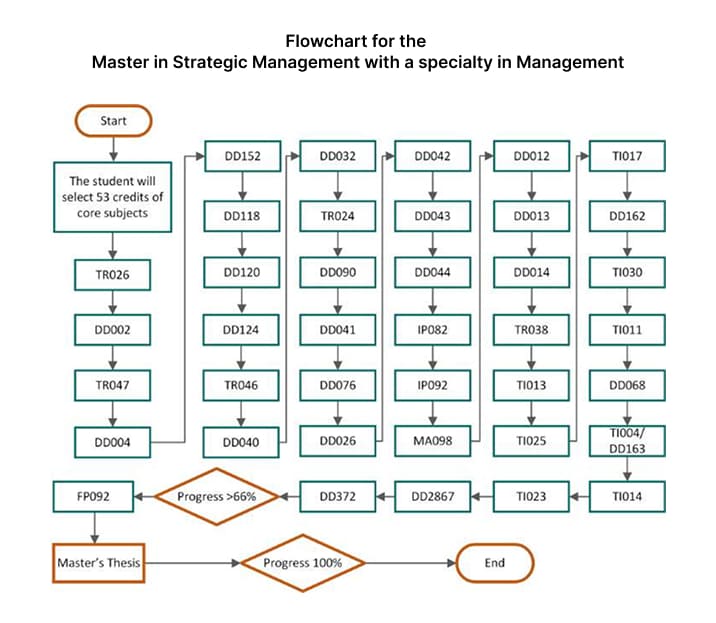
Optative Modules
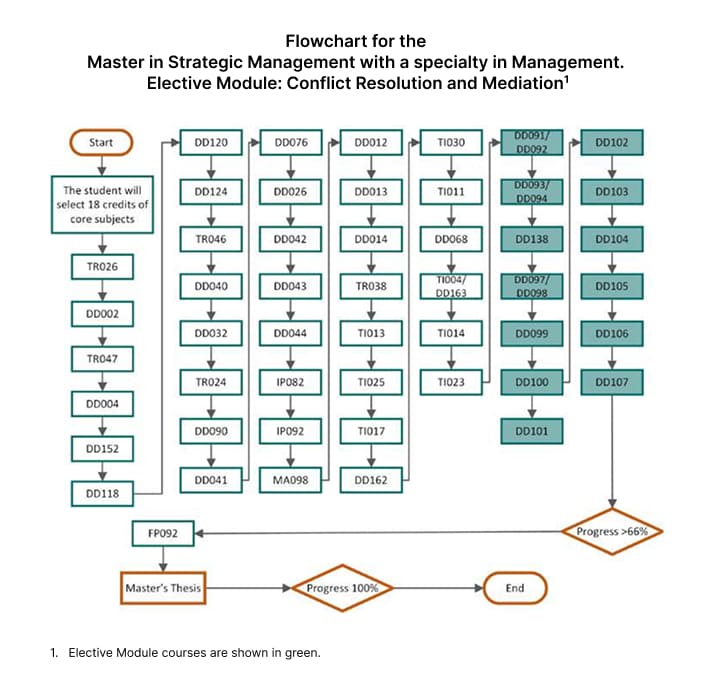
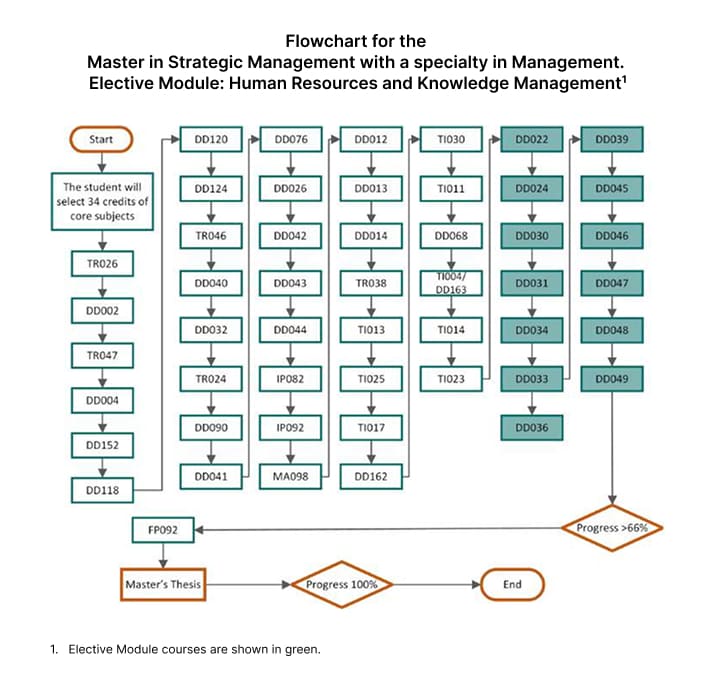
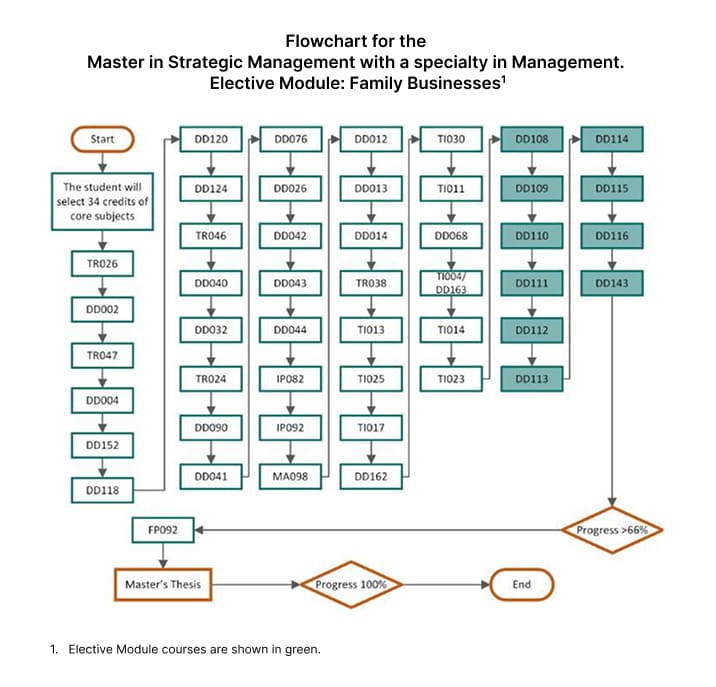

Optative Modules
The program offers different optative modules focusing on specific areas relevant to strategic management professionals:
This module brings together the fundamental concepts related to people management and leadership in the 21st century within the framework of integrated organizational management and the different processes and tools useful for its effective implementation.
| OPTATIVE MODULE – HUMAN RESOURCES AND KNOWLEDGE MANAGEMENT | ||||
|---|---|---|---|---|
| DD022 | Organizational Structure and Change | N/A | 2 | 30 |
| DD024 | Organizational Culture and Climate | N/A | 2 | 30 |
| DD030 | Position Analysis, Description, and Value | N/A | 2 | 30 |
| DD031 | Recruitment, Selection, and Promotion | N/A | 2 | 30 |
| DD034 | Training and Career Plans | N/A | 2 | 30 |
| DD033 | Compensations and Incentives | N/A | 2 | 30 |
| DD036 | Human Resources Audit | N/A | 1 | 15 |
| DD039 | Interpersonal Communication Technique | N/A | 1 | 15 |
| DD045 | Emotional Intelligence | N/A | 1 | 15 |
| DD046 | Personal Marketing | N/A | 1 | 15 |
| DD047 | Intellectual Capital | N/A | 1 | 15 |
| DD048 | Quality as a Management Tool for Human Resources | N/A | 1 | 15 |
This module is framed within the perspective of conflict studies. It offers participants an updated perspective on theoretical knowledge of conflict and develops skills and abilities in the different techniques of conflict/dispute resolution/transformation.
| OPTATIVE MODULE – CONFLICT RESOLUTION AND MEDIATION | ||||
|---|---|---|---|---|
| DD091/DD092 | Conflict Theory | N/A | 5 | 75 |
| DD093/DD094 | Emotion, Communication, and Conflict | N/A | 4 | 60 |
| DD138 | Conflict Resolution/Transformation Principles and Processes | N/A | 5 | 75 |
| DD097/DD098 | Mediation | N/A | 4 | 60 |
| DD099 | National and International Legislation on Mediation and Other Conflict Resolution Procedures | N/A | 3 | 45 |
| DD100 | Conflict Resolution/Transformation in the School | N/A | 2 | 30 |
| DD101 | Conflict Resolution/Transformation in the Family | N/A | 2 | 30 |
| DD102 | Conflict Resolution/Transformation in the Community | N/A | 2 | 30 |
| DD103 | Conflict Resolution/Transformation in the Organization | N/A | 2 | 30 |
| DD104 | Conflict Resolution/Transformation in Corrections | N/A | 2 | 30 |
| DD105 | Conflict Resolution/Transformation in the Health Field | N/A | 1 | 15 |
| DD106 | International Conflict Resolution/Transformation | N/A | 2 | 30 |
This program covers the basic concepts associated with the management and administration of family businesses, as well as the different processes and useful tools for their effective leadership.
| OPTATIVE MODULE – FAMILY BUSINESSES | ||||
|---|---|---|---|---|
| DD108 | Family Business Concepts and Characteristics | N/A | 2 | 30 |
| DD109 | Succession and Continuity in Family Business | N/A | 2 | 30 |
| DD110 | The Systematic Focus Applied to Conflict in Family Businesses | N/A | 2 | 30 |
| DD111 | Professionalization of Family Business | N/A | 2 | 30 |
| DD112 | Government Structures and Bodies | N/A | 2 | 30 |
| DD113 | The Family Protocol | N/A | 2 | 30 |
| DD114 | Property Management in Family Businesses | N/A | 1 | 15 |
| DD115 | Key Factors for Success in the Family Business | N/A | 1 | 15 |
| DD116 | Creation and Internationalization of Family Businesses | N/A | 2 | 30 |
| DD143 | Basic Legal Aspects of the Family Business | N/A | 3 | 45 |
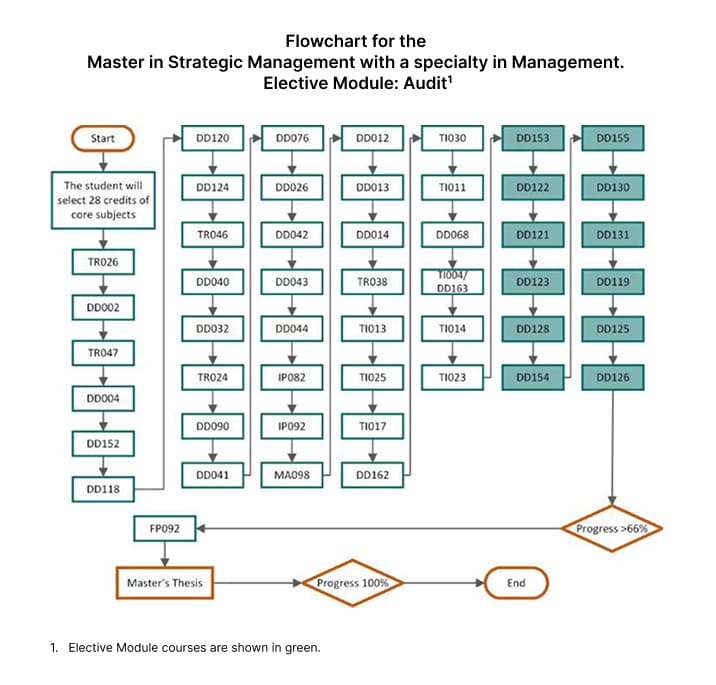
Auditing orientation provides first-rate training, reinforced by theory, based on the experience of auditing and consulting companies and multinationals with excellent theoretical and practical foundations.
| OPTATIVE MODULE - AUDIT | ||||
|---|---|---|---|---|
| DD153 | Financial Valuation for IAS | N/A | 2 | 30 |
| DD122 | International Accounting Standards | N/A | 4.5 | 67.5 |
| DD121 | International Taxation and Financing | N/A | 1.5 | 22.5 |
| DD123 | Financial Statement Analysis | N/A | 2 | 30 |
| DD128 | Administration and Planning of Audits | N/A | 1 | 15 |
| DD154 | Internal Control | N/A | 2 | 30 |
| DD155 | Documentation, Testing, and Auditing Risks | N/A | 2 | 30 |
| DD130 | Auditing Procedures by Area | N/A | 5 | 75 |
| DD131 | Auditing Reports | N/A | 1 | 15 |
| DD119 | Statistical Sampling | N/A | 2 | 30 |
| DD125 | Total Quality Costs | N/A | 2 | 30 |
| DD126 | Budget and Public Accounting | N/A | 3 | 45 |
| OPTATIVE MODULE - INTEGRATED MANAGEMENT OF THE ENVIRONMENT, QUALITY, AND OCCUPATIONAL RISK PREVENTION | ||||
|---|---|---|---|---|
| IP059 | Fundamentals in Labor Risk Prevention | N/A | 2 | 30 |
| IP060 | Workplace Security | N/A | 4 | 60 |
| IP003 | Workplace Hygiene | N/A | 5 | 75 |
| IP062 | Ergonomics | N/A | 3 | 45 |
| IP071 | Applied Social Psychology | N/A | 2 | 30 |
| IP078 | Background and Actual Situation of Integrated Management | N/A | 3 | 45 |
| IP9001 | Introduction and Fundaments of Integrated Management Systems | N/A | 2 | 30 |
| IP9002 | Advantages and Difficulties of the Integration of Systems, Grades, Modes, and Integration System Models | N/A | 3 | 45 |
| IP9003 | Integration of Management Systems Based on Standards and Processes | N/A | 2 | 30 |
| IP9004 | Implementation of the Integrated Management System | N/A | 2 | 30 |
| IP051 | Water Management: Basic Principles | N/A | 5 | 75 |
| IP052 | Basic Waste Management | N/A | 3 | 45 |
| IP053 | Atmospheric Contamination Treatment | N/A | 5 | 75 |
| IP054 | Treatment of Contaminated Soils | N/A | 4 | 60 |
| IP002 | Workplace Security | N/A | 7 | 105 |
| IP076 | Workplace Hygiene | N/A | 7 | 105 |
| IP073 | Ergonomics and Applied Psychology | N/A | 7 | 105 |
| IP064 | Training and Communication | N/A | 1 | 15 |
| IP004 | Occupational Health | N/A | 2 | 30 |
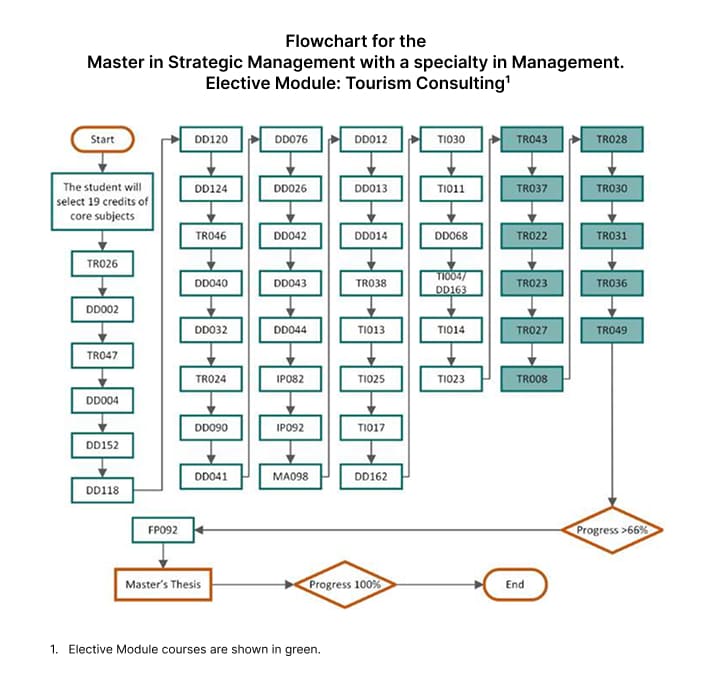
| OPTATIVE MODULE - TOURISM CONSULTING | ||||
|---|---|---|---|---|
| TR043 | Tourism Foundations | N/A | 3 | 45 |
| TR037 | IT in the Tourism Industry | N/A | 4 | 60 |
| TR022 | Hotel Business Management | N/A | 4.5 | 67.5 |
| TR023 | Food and Drinks Management | N/A | 4.5 | 67.5 |
| TR027 | Cultural Heritage and Tourism | N/A | 3 | 45 |
| TR008 | Territory as a Tourist Resource | N/A | 3 | 45 |
| TR028 | Environmental Impacts on Tourism Activities | N/A | 3 | 45 |
| TR030 | Rural Tourism and Sustainable Development | N/A | 3 | 45 |
| TR031 | Alternative Tourism and Ecotourism | N/A | 3 | 45 |
| TR036 | Strategy and Tourism Businesses on the Internet | N/A | 3 | 45 |
| TR049 | Quantitative Analysis of Tourism | N/A | 4 | 60 |
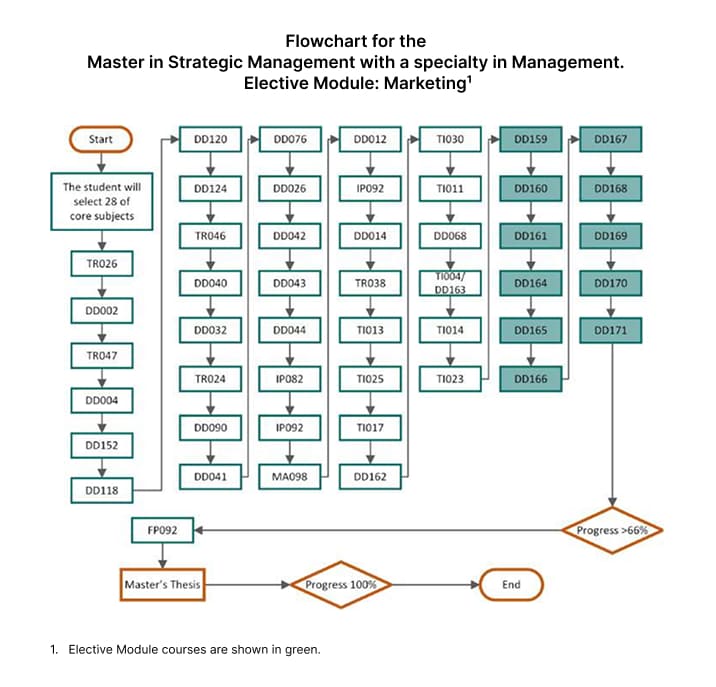
This module integrates the fundamental concepts of 21st-century marketing thought and management within the framework of strategic direction. It employs an integrative approach across public and private, for-profit and non-profit organizations, covering the essential processes, techniques, and tools for effective management.
| OPTATIVE MODULE - MARKETING | ||||
|---|---|---|---|---|
| DD159 | Introduction to the New Marketing | N/A | 2 | 30 |
| DD160 | Market Research | N/A | 2 | 30 |
| DD161 | Consumer-buyer Behavior | N/A | 2 | 30 |
| DD164 | Relational Marketing | N/A | 2 | 30 |
| DD165 | Marketing Audits | N/A | 1 | 15 |
| DD166 | Product Management and Brand Policies | N/A | 3 | 45 |
| DD167 | Price Management Policies | N/A | 3 | 45 |
| DD168 | Distribution Management Policies | N/A | 3 | 45 |
| DD169 | Communication Management Policies | N/A | 3 | 45 |
| DD170 | Service Marketing | N/A | 2 | 30 |
| DD171 | Control and Marketing Plan | N/A | 2 | 30 |
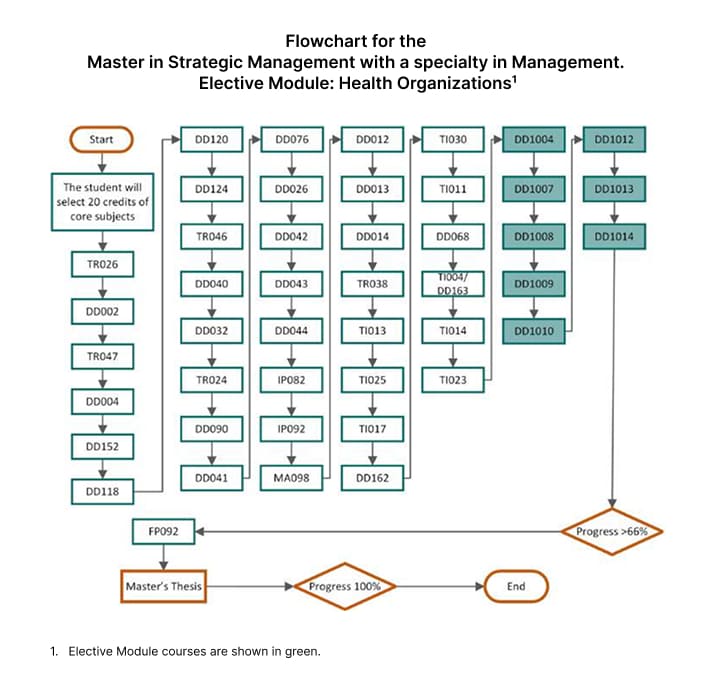
This optative module aims to provide comprehensive training with tools and concepts that enable professionals to make sound decisions in the management, administration, evaluation, and planning of the necessary processes to achieve institutional objectives. This is achieved through theoretical knowledge, practical case studies, and exercises that provide participants with a deeper understanding of the management of this type of organization.
| OPTATIVE MODULE – HEALTHCARE ORGANIZATIONS | ||||
|---|---|---|---|---|
| DD1004 | Health Economy | N/A | 5 | 75 |
| DD1007 | Health Planning | N/A | 4 | 60 |
| DD1008 | Health Services Management | N/A | 3 | 45 |
| DD1009 | Health Marketing | N/A | 3 | 45 |
| DD1010 | Assistance Quality and Patient Security | N/A | 4 | 60 |
| DD1012 | Health Systems | N/A | 4 | 60 |
| DD1013 | Clinical Epidemiology | N/A | 5 | 75 |
| DD1014 | Biostatistics | N/A | 5 | 75 |
Degree
Once the subjects and master’s thesis are approved and all academic, administrative, and financial requirements have been met, the following degree will be issued:
MASTER’S DEGREE IN STRATEGIC MANAGEMENT WITH A SPECIALTY IN MANAGEMENT
Testimonials
- “I would like to thank the University for its program and support, and especially my Final Project Director, Dr. Lina Pulgarín, because her guidance and help were invaluable.” End of Course Survey.
- “Everything was excellent, very little could have been better.” End of Course Survey.
- “Excellent program.” End of Course Survey.
- “I am grateful to have received information that is extremely useful for my professional work and research.” End of Course Survey.ç
- “I am more than satisfied, I really enjoyed it. Thank you, FUNIBER and UNIB; it is a well-structured, excellent program. I am very pleased as I took advantage of the knowledge you provided. Thank you.” End of Course Survey.
- “It is an excellent program. Personally, I am highly satisfied and have had very positive results at work.” End of Course Survey.
- “Excellent program and up to date.” End of Course Survey.
- “The academic program provided guidance, advice, knowledge acquisition, and the necessary tools for mediation and conflict resolution in different social and work areas. Similarly, through practical training and research work, it was possible to build closer ties with the community and provide effective support.” End of Course Survey.
- “The experience was wonderful, a lot of work, but the structure and organization of the Virtual Campus helped me. It was a challenge for me, but I did it, thank God.” End of Course Survey.