
Description
This master’s program integrates concepts related to the design, operation, and management of projects—from their initial development to subsequent analysis—regardless of their origin or purpose. This is achieved through training in the use of up-to-date computer-based tools within the professional field, along with the pedagogical application of theoretical foundations and practical case studies in project planning and management technologies.
The program is specifically designed for university-trained professionals from all areas of knowledge who are interested in engaging in the field of project management in a responsible and disciplined manner. It is aimed at those who wish to work in teaching and research related to projects and/or in professional settings, holding executive or consulting positions in project development and management.
Learning Objectives
Competencies
- Provide a high level of academic discipline to university-trained professionals from all areas of knowledge who are interested in becoming involved in the field of project management in a responsible manner, enabling them to work in project teaching and research and/or in professional practice.
- Deliver instruction in new or unfamiliar environments within broad contexts related to the design, operation, and management of projects—from their initial development to their later analysis, regardless of origin or purpose—so that students can apply acquired knowledge, make judgments, take decisions, and solve problems.
- Provide training in the use of up-to-date computer-based tools used in the professional field, as well as in the pedagogical application of theoretical foundations and practical case studies, and in the use of technological tools for project planning and management, along with scientific research tools that allow students to conduct research or produce creative work ethically and with demonstrated mastery of the material.
Outcomes
At the end of the program, students will be able to:
- Define basic concepts in the field of project formulation, management, and direction.
- Recognize and analyze the fundamental aspects of a project to strategically define its objectives, the service to be delivered, how it will be provided, the ergonomics required, and the functional aspects of the project.
- Design a preliminary project considering its essential components—from identifying the problematic situation to presenting the proposed solution—recognizing the necessary elements to define and specify for future management and implementation.
- Analyze key aspects of project management throughout its lifecycle: identifying stakeholders, understanding user requirements, managing work teams, and evaluating the basic factors that determine feasibility and viability.
- Identify elements that contribute to project quality, safety, and reliability, as well as those that present significant risks, including analyzing the potential impact a project may have on its environment.
- Develop a balanced scorecard with indicators related to human resource management, work-breakdown structures, activity organization, and other factors that support strategic business decision-making.
- Incorporate project management and leadership tools to ensure the effective handling of resources, scheduling, and available ICT tools used in the field of project management.
Who Should Apply
The training methodology proposed for the MDGDP, together with the clarity, breadth, and instructional design of its content, allows the Master’s in Project Design, Management, and Direction to be directed toward university-trained professionals from all areas of knowledge who are interested in becoming involved in the world of projects in a responsible manner and with a high level of academic discipline. It is intended for those who wish to work in the field of project teaching and research and/or in the professional arena, holding executive or advisory positions in project-related roles.
Duration
Regarding the distribution of time, the following is established:
- Although it is a distance-learning program and does not require in-person classes, it follows a collaborative and cooperative learning methodology. Therefore, each cohort has a specific start date beginning on the date indicated in the official call, once enrollment is formalized and provided that seats are available. The Design phase of the program becomes available once the student has completed the requirement of two courses in the Management area.
- For academic and learning reasons, the minimum duration of the program is twenty-one months.
- The maximum time allowed to complete the program is twenty-four months. Within this period, the student must have successfully completed all evaluated activities and must have passed the Master’s Thesis.
General Education: Maximum of 53 credits
Required: 13 credits
Electives: Maximum of 14 credits
Depending on the student’s prior academic background, they will complete the number of credits needed to reach the 66 credits required by the program.
Structure
General Education: Maximum 53 credits
Required: 13 credits
Maximum 14 credits
Depending on the student’s prior academic background, they will complete the number of credits needed to reach the 66 credits required by the program.
| MASTER IN PROJECT DESIGN, ADMINISTRATION, AND MANAGEMENT | |||||
|---|---|---|---|---|---|
| CODE | SUBJECT | PREREQUISITES | CREDIT | ||
| GENERAL EDUCATION | |||||
| DD050 | Introduction to Projects | N/A | 1 | ||
| DD051 | Project System Design | N/A | 2 | ||
| DD052 | Analysis of Provision of Services | N/A | 2 | ||
| DD053 | Functional Analysis of the Project | N/A | 2 | ||
| DD054 | Project Ergonomics | N/A | 2 | ||
| DD055 | Project Security and Reliability | N/A | 2 | ||
| DD056 | Environment in a Project | N/A | 2 | ||
| DD057 | Project Specifications | N/A | 2 | ||
| DD058 | Project Draft Preparation | N/A | 3 | ||
| PROJECT MANAGEMENT | |||||
| DD070 | Introduction to Project Management | N/A | 1 | ||
| TR038 | Project Planning and Management | N/A | 3 | ||
| DD072 | Computing Tools for Project Management | N/A | 2 | ||
| DD073 | Project Monitoring and Control | N/A | 2 | ||
| DD074 | Project Evaluation | N/A | 2 | ||
| DD075 | Trust Management: Risk and Quality | N/A | 2 | ||
| TR046 | Strategic Management of Human Resources | N/A | 2 | ||
| DD133 | Occupational Risk Prevention: OHSAS 18001 | N/A | 2 | ||
| DD077 | Project Communication | N/A | 1 | ||
| PROJECT ADMINISTRATION | |||||
| DD026 | Collaborative Work in Virtual Environments | N/A | 1 | ||
| DD076 | Management Without Distances | N/A | 1 | ||
| DD044 | Public Presentation Techniques | N/A | 1 | ||
| TR026 | Business Management and Administration | N/A | 3 | ||
| DD014 | Strategic Management and Planning | N/A | 3 | ||
| DD040 | Negotiation and Conflict Resolution Techniques | N/A | 2 | ||
| DD041 | Management Techniques for Work Teams | N/A | 2 | ||
| DD068 | Knowledge Management and Organizational Learning | N/A | 2 | ||
| TI025 | E-business and its Integration With Management Corporate Systems | N/A | 3 | ||
| ELECTIVES | OPTATIVE MODULE: IN INTERNATIONAL COOPERATION: IN THE AREA OF KNOWLEDGE APPLIED TO PROJECT DESIGN, ADMINISTRATION AND MANAGEMENT | ||||
| PC012 | International Collaboration System | N/A | 1 | ||
| PC013 | Logic Framework | N/A | 2 | ||
| DD090 | Corporate Social Responsibilities and Ethics | N/A | 3 | ||
| PC002 | Collaboration and Development Theory | N/A | 3 | ||
| TR047 | Financial Management | N/A | 3 | ||
| DD102 | Resolution Transformation of Conflict in the Community | N/A | 2 | ||
| REQUIRED | MASTER THESIS | ||||
| FP092 | Methodology of Scientific Research | N/A | 3 | ||
| TFC/Practicum | N/A | 10 | |||
| TOTAL | 66 | ||||
Diagram
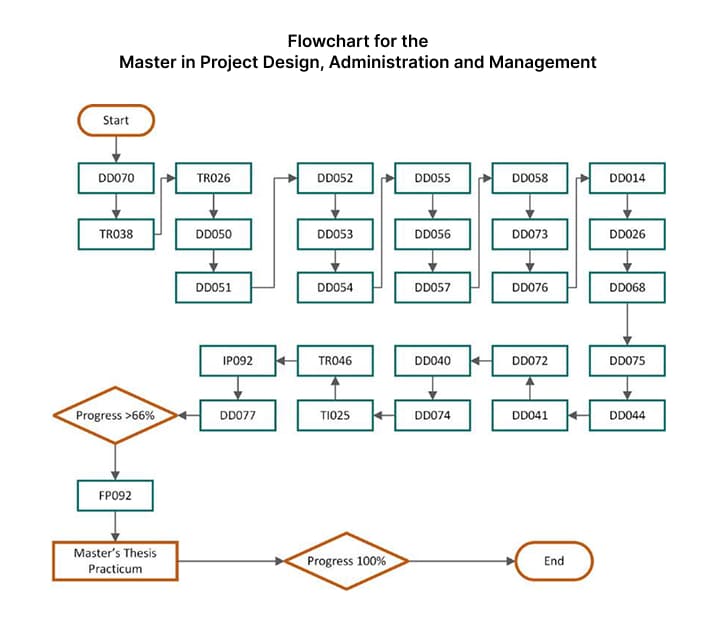
Optative Modules

Optative Modules
The credit structure of this optative module is the following:
| OPTATIVE MODULE: IN INTERNATIONAL COOPERATION: IN THE AREA OF KNOWLEDGE APPLIED TO PROJECT DESIGN, ADMINISTRATION AND MANAGEMENT | |||||
|---|---|---|---|---|---|
| PC012 | International Collaboration System | N/A | 1 | 15 | |
| PC013 | Logic Framework | N/A | 2 | 30 | |
| DD090 | Corporate Social Responsibilities and Ethics | N/A | 3 | 45 | |
| PC002 | Collaboration and Development Theory | N/A | 3 | 45 | |
| TR047 | Financial Management | N/A | 3 | 45 | |
| DD102 | Resolution Transformation of Conflict in the Community | N/A | 2 | 30 | |
Degree
Upon passing the courses and the Master's Thesis, and satisfying any other academic, administrative, and financial requirements established and demanded by the university, the following academic degree will be awarded:
MASTER IN PROJECT DESIGN, ADMINISTRATION, AND MANAGEMENT
Testimonials
- “This type of learning is very good, accessible and guaranteed, since there are several of us professionals that because of work cannot count with these types of programs. Thank you”. End of Course Survey.
- “Good academic program, it has been a good study and learning experience to update and expand knowledge and improve the skills in professional activities”. End of Course Survey.
- “Eu adorei o Programa Acadêmico oferecido por vocês. Gostaria muito de fazer um Doutorado também através de vocês, porém, a certificação oferecida não é compatível com as certificações do Brasil e nesse caso, não tivemos amparo algum por parte dessa universidade em fazer com que nosso diploma fosse reconhecido aqui em nosso país por outras universidades parceiras”. End of Course Survey.
- “The dynamic during the educational program accomplished my expectations”. End of Course Survey.
- “Excellent orientation by the entire University team”. End of Course Survey.
- “It has been a blessing for my life. I am about to be 50 years old. The master’s has supported the professional leap that I had been waiting for, for some time”. End of Course Survey.
- “It has been a very enriching experience in my professional and personal life in every sense of the way”. End of Course Survey.
- “The entire process was very good, the subjects, the way the program is structured, the learning process and the tools. I recommend it 100%”. End of Course Survey.
- “Didactic, practical and real learning of the studied program and the degree awarded. Excellent in all aspects of the program structure. Thanks to UNINI for giving me the opportunity of reaching the postgraduate level. It has complemented my profession as a civil engineer”. End of Course Survey.