
Description
The Master in Public Health at the Universidad Internacional Iberoamericana (UNIB) is a program that provides participants with a comprehensive training, equipping graduates with the competencies to address public health issues from various perspectives through interventions aimed at promoting, protecting, and restoring community health.
The master’s program is designed to contribute to students’ education through an academic curriculum that enables them to develop reflective, critical, and humanistic thinking through an academic framework focused on the development of knowledge that generates skills and sustainable solutions to address the needs associated with professional practice in the field of public health.
The master's program offers high-quality training grounded in methodological approaches and evidence-based interventions. The program trains students in a highly relevant professional field—public health—and offers four electives that allow students to delve deeper into key areas such as community nutrition, occupational health, environmental health, and management.
Learning Objectives
General Competencies:
- Train professionals capable of addressing major public health challenges by designing and managing collective actions for the protection, restoration, and promotion of health, ensuring high-quality and relevant healthcare for the population.
- Facilitate teaching in new or unfamiliar environments within broad contexts, equipping learners with sufficient knowledge and resources to make judgments, make decisions, and solve problems.
- Provide scientific research tools that enable students to conduct research or produce innovative work, showing mastery of the subject matter and acting ethically.
Specific Competencies:
- Strengthen the theoretical and methodological foundations of public health, with an emphasis on activities that foster logical thinking and scientific reasoning.
- Assess the population’s health needs in order to address its actual and potential needs, taking into account its social determinants and rights.
- Evaluate healthcare systems to propose improvement strategies that are adapted to the needs of the population.
- Analyze economic and social determinants as well as health policies, understanding how they integrate into public health interventions.
- Design and evaluate evidence-based public health plans, programs, projects, and services aimed at promoting, restoring, and protecting population health.
- Be able to detect health problems early and propose solutions that improve quality of life.
Who Should Apply
The program is designed for two student profiles, each with distinct characteristics but complementary perspectives, enabling a comprehensive academic approach:
- Professionals and university graduates—particularly in the fields of life sciences (medicine, nursing, biology, veterinary medicine, etc.), environmental sciences, statistics, economics, sociology, chemistry, and pharmacy, among others—who wish to receive training and education to perform public health functions in any of its areas (whether in practice or research).
- Other professionals and university graduates: those seeking training that will equip them with the tools they need to perform effectively in their roles and provide the best possible service.
Duration
The maximum time available to complete the master’s program is 24 months. The credit structure of the MASTER IN PUBLIC HEALTH is as follows:
General Education: 48 credits
Required: 13 credits
Electives: 9 credits
Structure
| MASTER IN PUBLIC HEALTH | |||||
|---|---|---|---|---|---|
| CODE | SUBJECT | PREREQUISITE | CREDITS | ||
| TRAINING COMPLEMENTS | |||||
| SP027 | Writing, Reading, and Comprehension of Written Works | N/A | - | ||
| CI109 | Basic Mathematics | N/A | - | ||
| SP026 | Fundamental Concepts in Public Health | N/A | - | ||
| GENERAL EDUCATION | |||||
| SP001 | Contextualization of Public Health | N/A | 2 | ||
| BT009 | General Bioethics | N/A | 3 | ||
| SP002 | Social Determinants in Health | N/A | 2 | ||
| SN1013 | Epidemiology I | N/A | 4 | ||
| SP003 | Demographics and Public Health | N/A | 2 | ||
| SP004 | Health-Disease Process and Equity | N/A | 3 | ||
| DD1012 | Healthcare Systems | N/A | 4 | ||
| SN356 | Epidemiology II | N/A | 4 | ||
| DD1008 | Management of Health Services | N/A | 3 | ||
| DD1004 | Health Economics | N/A | 5 | ||
| CSJ024 | Statistics I | N/A | 4 | ||
| SP005 | Health and Social Protection Policies | N/A | 4 | ||
| SP006 | Public Health Monitoring | N/A | 3 | ||
| SP007 | Design and Evaluation of Public Health Programs | N/A | 3 | ||
| SN331 | FP Health Seminar | N/A | 2 | ||
| ELECTIVES | OPTATIVE MODULE: ENVIRONMENTAL HEALTH | ||||
| MA030 | Pollutants in the Environment | N/A | 2 | ||
| SP009 | Environmental Risks and Public Health | N/A | 3 | ||
| SP010 | Environmental Toxicology and Public Health | N/A | 4 | ||
| OPTATIVE MODULE: COMMUNITY NUTRITION | |||||
| SN071 | Public Health Applied to Nutrition | N/A | 4 | ||
| SP018 | Tools for the Development of Community Nutrition Programs | N/A | 2 | ||
| SN066 | Food, Health, and Communication | N/A | 3 | ||
| OPTATIVE MODULE: OCCUPATIONAL HEALTH | |||||
| IP004 | Occupational Medicine | N/A | 2 | ||
| SP011 | Occupational Toxicology | N/A | 4 | ||
| SP012 | Prevention of Specific Occupational Hazards | N/A | 3 | ||
| OPTATIVE MODULE: PUBLIC HEALTH MANAGEMENT | |||||
| DD1000 | Strategic Management of Human Resources | N/A | 2 | ||
| DD1019 | Team Management Techniques | N/A | 2 | ||
| DD1018 | Management Techniques and Organizational Leadership | N/A | 2 | ||
| SP013 | Assistance Communication | N/A | 3 | ||
| REQUIRED | |||||
| DO016 | Methodology of Scientific Research | N/A | 3 | ||
| Thesis | N/A | 10 | |||
| TOTAL | 70 | ||||
Diagram
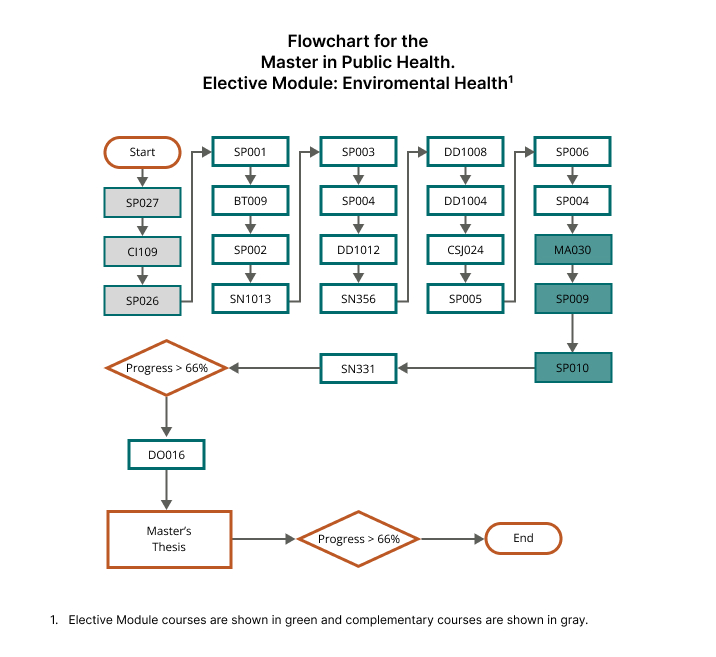
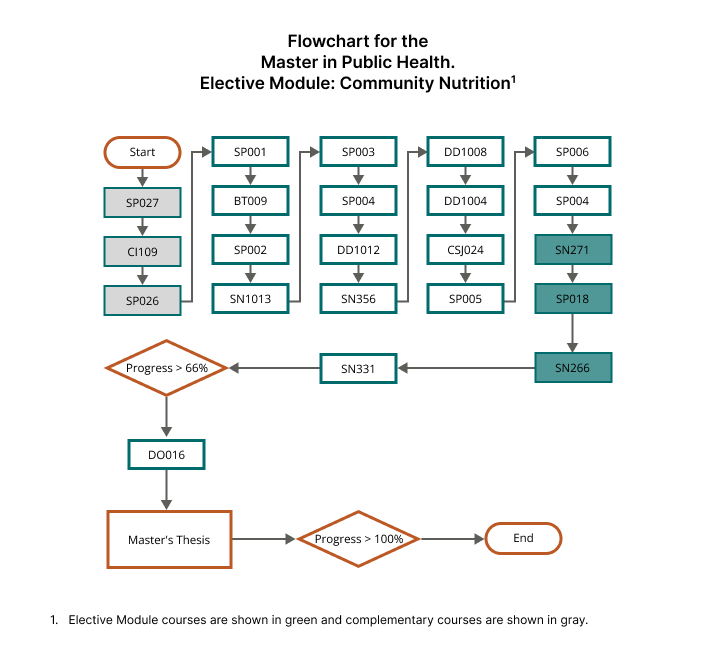
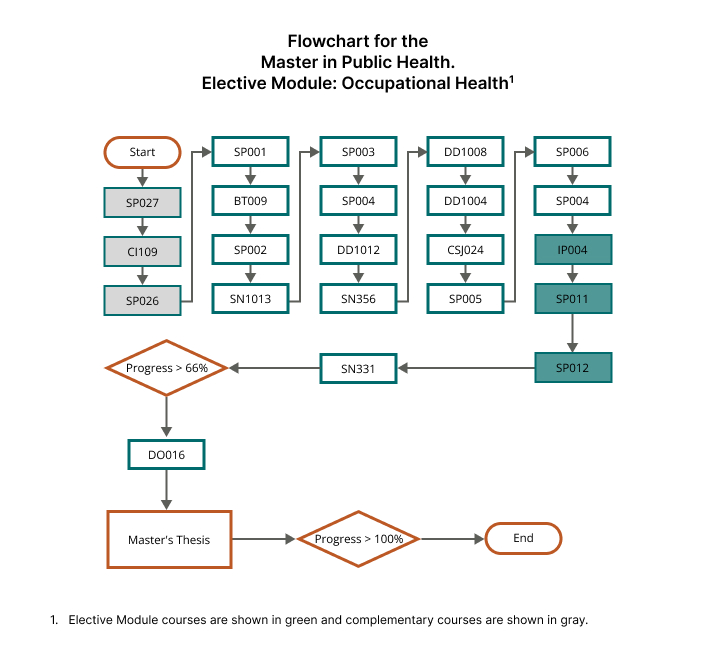
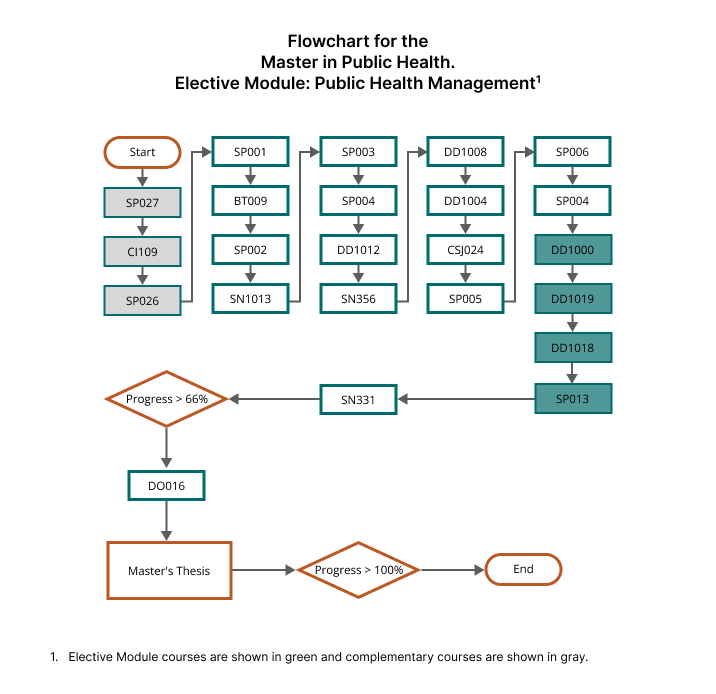
Optative Modules
| OPTATIVE MODULE: ENVIRONMENTAL HEALTH | |||
|---|---|---|---|
| MA030 | Pollutants in the Environment | N/A | 2 |
| SP009 | Environmental Risks and Public Health | N/A | 3 |
| SP010 | Environmental Toxicology and Public Health | N/A | 4 |
| OPTATIVE MODULE: COMMUNITY NUTRITION | |||
|---|---|---|---|
| SN071 | Public Health Applied to Nutrition | N/A | 4 |
| SP018 | Tools for the Development of Community Nutrition Programs | N/A | 2 |
| SN066 | Food, Health, and Communication | N/A | 3 |
| OPTATIVE MODULE: OCCUPATIONAL HEALTH | |||
|---|---|---|---|
| IP004 | Occupational Medicine | N/A | 2 |
| SP011 | Occupational Toxicology | N/A | 4 |
| SP012 | Prevention of Specific Occupational Hazards | N/A | 3 |
| OPTATIVE MODULE: PUBLIC HEALTH MANAGEMENT | ||||
|---|---|---|---|---|
| DD1000 | Strategic Management of Human Resources | N/A | 2 | |
| DD1019 | Team Management Techniques | N/A | 2 | |
| DD1018 | Management Techniques and Organizational Leadership | N/A | 2 | |
| SP013 | Assistance Communication | N/A | 3 | |
Degree
Upon successful completion of the subjects and Master's Thesis, and upon meeting all academic, administrative, and financial requirements established by the university, the following degree will be issued:
MASTER’S DEGREE IN PUBLIC HEALTH